Showing posts with label Daguerreotype. Show all posts
Wednesday, August 24, 2011
Wednesday, July 20, 2011
The World's Most Expensive Camera... No It's Not A Leica
Saturday 29 May 2101, WestLicht Photographica Auction auctioned one of the first Daguerreotype cameras ever produced. The wooden sliding-box camera was made in Paris in September 1839 by Alphonse Giroux, a few weeks after the first public announcement of photography.
It was discovered recently after having spent decades in private ownership in northern Germany. 'The outstanding original condition of the 170-year-old apparatus is remarkable,' said the auction house, which believed the device would fetch in excess of its previous record of €576,000.
However, the final bid went beyond WestLicht's expectations. The camera sold for €732,000 ($1,044,096.70 U.S. dollars), making it the most expensive camera in the world. "The duel of bidders in the auction room ended after twenty minutes with a record telephone bid," says the auction house. "With a starting price of €200,000, the wood-built sliding-box camera changed owners for €732,000 and thus became not only the oldest but also the most expensive camera in the world. With that WestLicht has broken its own record of €576,000, which was set in 2007. No less spectacular is the price achieved by the mercury box that goes with the Daguerreotype – the extremely rare accessory was sold for €144,600."
Taking part in the auction were numerous collectors, dealers, and institutions from all over the world, including bidders from Korea, Japan, the USA, and France.
(via British Journal of Photography)
It was discovered recently after having spent decades in private ownership in northern Germany. 'The outstanding original condition of the 170-year-old apparatus is remarkable,' said the auction house, which believed the device would fetch in excess of its previous record of €576,000.
However, the final bid went beyond WestLicht's expectations. The camera sold for €732,000 ($1,044,096.70 U.S. dollars), making it the most expensive camera in the world. "The duel of bidders in the auction room ended after twenty minutes with a record telephone bid," says the auction house. "With a starting price of €200,000, the wood-built sliding-box camera changed owners for €732,000 and thus became not only the oldest but also the most expensive camera in the world. With that WestLicht has broken its own record of €576,000, which was set in 2007. No less spectacular is the price achieved by the mercury box that goes with the Daguerreotype – the extremely rare accessory was sold for €144,600."
Taking part in the auction were numerous collectors, dealers, and institutions from all over the world, including bidders from Korea, Japan, the USA, and France.
(via British Journal of Photography)
Photography Pioneer Profile ~ Louis Daguerre
On January 7, 1839, members of the French Académie des Sciences were shown products of an invention that would forever change the nature of visual representation: photography. The astonishingly precise pictures they saw were the work of Louis-Jacques-Mandé Daguerre (1787–1851), a Romantic painter and printmaker. Each daguerreotype (as Daguerre dubbed his invention) was a one-of-a-kind image on a highly polished, silver-plated sheet of copper. He worked with Joseph Nicéphore Niépce (the inventor of photography) to perfect the medium. Niépce had achieved primitive but real results as early as 1826. By the time Niépce died in 1833, the partners had yet to come up with a practical, reliable process.
Not until 1838 had Daguerre's continued experiments progressed to the point where he felt comfortable showing examples of the new medium to selected artists and scientists in the hope of lining up investors. François Arago, a noted astronomer and member of the French legislature, was among the new art's most enthusiastic admirers. He became Daguerre's champion in both the Académie des Sciences and the Chambre des Députés, securing the inventor a lifetime pension in exchange for the rights to his process. Only on August 19, 1839, was the revolutionary process explained, step by step, before a joint session of the Académie des Sciences and the Académie des Beaux-Arts, with an eager crowd of spectators spilling over into the courtyard outside.
Daguerre's name is one of the 72 names inscribed on the Eiffel tower.
Not until 1838 had Daguerre's continued experiments progressed to the point where he felt comfortable showing examples of the new medium to selected artists and scientists in the hope of lining up investors. François Arago, a noted astronomer and member of the French legislature, was among the new art's most enthusiastic admirers. He became Daguerre's champion in both the Académie des Sciences and the Chambre des Députés, securing the inventor a lifetime pension in exchange for the rights to his process. Only on August 19, 1839, was the revolutionary process explained, step by step, before a joint session of the Académie des Sciences and the Académie des Beaux-Arts, with an eager crowd of spectators spilling over into the courtyard outside.
Daguerre's name is one of the 72 names inscribed on the Eiffel tower.
Daguerreotype of Louis Daguerre in 1844 by Jean-Baptiste Sabatier-Blot ~ 1844
The process seemed magical. Each daguerreotype is a remarkably detailed, one-of-a-kind photographic image on a highly polished, silver-plated sheet of copper, sensitized with iodine vapors, exposed in a large box camera, developed in mercury fumes, and stabilized (or fixed) with salt water or "hypo" (sodium thiosulphate). Although Daguerre was required to reveal, demonstrate, and publish detailed instructions for the process, he wisely retained the patent on the equipment necessary to practice the new art.
[via The MET]
One of the very first successful daguerreotypes "Daguerre Atelier" 1837
"Boulevard du Temple", taken by Daguerre in 1838 in Paris, was the first photograph of a person. The image shows a street, but because of the over ten minute exposure time the moving traffic does not appear. The exceptions are the man and shoe-shine boy at the bottom left, and two people sitting at a table nearby who stood still long enough to have their images captured. [wiki]
The process seemed magical. Each daguerreotype is a remarkably detailed, one-of-a-kind photographic image on a highly polished, silver-plated sheet of copper, sensitized with iodine vapors, exposed in a large box camera, developed in mercury fumes, and stabilized (or fixed) with salt water or "hypo" (sodium thiosulphate). Although Daguerre was required to reveal, demonstrate, and publish detailed instructions for the process, he wisely retained the patent on the equipment necessary to practice the new art.
[via The MET]
One of the very first successful daguerreotypes "Daguerre Atelier" 1837
"Boulevard du Temple", taken by Daguerre in 1838 in Paris, was the first photograph of a person. The image shows a street, but because of the over ten minute exposure time the moving traffic does not appear. The exceptions are the man and shoe-shine boy at the bottom left, and two people sitting at a table nearby who stood still long enough to have their images captured. [wiki]
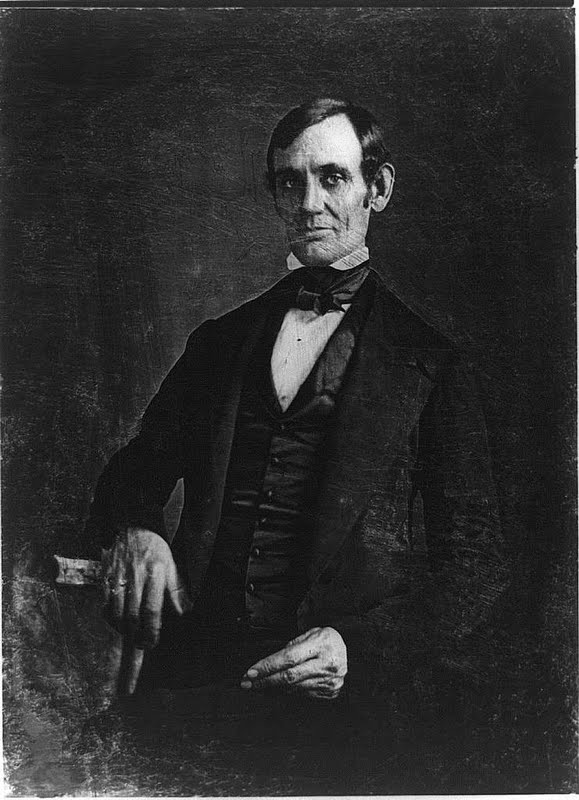
The first authenticated image of Abraham Lincoln was this daguerreotype of him as U.S.Congressman-elect in 1846, attributed to Nicholas H. Shepard of Springfield, Illinois
Ichiki Shirō's 1857 daguerreotype of Shimazu Nariakira (Japanese feudal lord), the earliest surviving Japanese photograph. Shimazu obtained the first daguerreotype camera ever imported into Japan. Ever fascinated by Western technology, he ordered his retainers (including Ichiki) to study it and produce working photographs. Due to the limitations of the lens used and the lack of formal training, it took many years for a quality photograph to be created, but on 17 September 1857, Ichiki created a portrait of Shimazu in formal attire. After Shimazu's death the photograph went missing but later turned up in a warehouse in 1975
The solar eclipse of July 28, 1851 is the first correctly exposed photograph of a solar eclipse, using the daguerreotype process.
The First Portrait Photograph ~ by Robert Cornelius 1839
On a sunny day in October 1839, Robert Cornelius set up his camera in the back of his father’s gas lamp-importing business on Chestnut Street in Center City, Philadelphia. After removing the lens cap, he sprinted into the frame, where he sat for more than a minute before covering up the lens. The picture he produced that day was the first photographic portrait. [via Daily News]
Robert Cornelius went on to become a celebrated portait photographer shooting Daguerreotypes (the process that Louis Daguerre invented). Daguerre’s own agent in Britain wrote that Cornelius’ pictures were “the most beautiful specimens of the daguerreotype then in existence.”
Despite his success, Cornelius gave up his photography business after only two years. Gas lighting was becoming the illumination of choice for new buildings, and there was more money to be made in lamps and chandeliers than in image-making. Ahh.... things have not changed much after all these years.
Robert Cornelius went on to become a celebrated portait photographer shooting Daguerreotypes (the process that Louis Daguerre invented). Daguerre’s own agent in Britain wrote that Cornelius’ pictures were “the most beautiful specimens of the daguerreotype then in existence.”
Despite his success, Cornelius gave up his photography business after only two years. Gas lighting was becoming the illumination of choice for new buildings, and there was more money to be made in lamps and chandeliers than in image-making. Ahh.... things have not changed much after all these years.
Self Portrait ~ Robert Cornelius Daguerreotype, 1839
Cornelius wrote on the back of this image “The first light Picture ever taken. 1839."
Thursday, July 7, 2011
Analog is Not Dead ~ Artists & Alchemists
Many artists have chosen to stay with traditional analog photography or have switched back from digital. While everybody and their brother has a digital camera plus a flickr account thinks they are a photographer, many artists are gravitating towards the traditional prints and negatives. The technical skill required to produce an image is high. Those who view photography merely as an instant gratification medium (with the advent of digital) will shy away from these traditional processes.
"If this were easy everybody would be doing it" ~ France Scully Osterman to her student.
Much like painting and sculpture the traditional photographic process is a major component of the art itself. (Particularly Daguerreotype and Collodion) I am glad to see this trend happen. I too have thought of getting back into analogue large format photography for my personal fine art work. (I will continue to use digital for my commercial work) Want to be separate from the herd? Hipstamatic silliness is not the way. Go Analogue young grasshopper. Long live the negative!
"If this were easy everybody would be doing it" ~ France Scully Osterman to her student.
Much like painting and sculpture the traditional photographic process is a major component of the art itself. (Particularly Daguerreotype and Collodion) I am glad to see this trend happen. I too have thought of getting back into analogue large format photography for my personal fine art work. (I will continue to use digital for my commercial work) Want to be separate from the herd? Hipstamatic silliness is not the way. Go Analogue young grasshopper. Long live the negative!
Subscribe to:
Posts (Atom)